
Fashion has always been a language of power. Long before social media turned every outfit into a statement, or an analysis prompt, political figures understood that what they wore communicated allegiance, aspiration, and ideology to an audience that extended far beyond the room they were standing in. From the ermine-lined robes of European monarchs to the revolutionary simplicity of sans-culottes, clothing has consistently served as one of the most direct and unmediated forms of political communication available to those in power.
American political history is no exception. The Reagan administration understood instinctively that image was inseparable from governance; a lesson drawn directly from Hollywood, where both Ronald and Nancy Reagan had built their identities before arriving at the White House. Their style was polished and exuberant: a performance of prosperity and confidence calibrated for the television age. A few years earlier, Jackie Kennedy wore American made suits that were patterned as duplicates of the latest designs from the House of Chanel, Jackie Kennedy was navigating the tension between American pride and international aspiration with extraordinary sophistication. Those wool jackets served as their diplomatic instruments. The Kennedys became the first American couple to deploy fashion deliberately as soft power, using style to strengthen alliances, particularly within NATO during some of the tensest years of the Cold War.
What these historical examples share is intentionality. The figures wearing these clothes understood the semiotics of what they had chosen, and the choices reinforced coherent political narratives. The suit matched the speech. The symbol aligned with the policy. Whether or not one agreed with the ideology, there was a readable consistency between image and message.
The current administration presents a far more complicated and, at times, contradictory picture. In a media landscape defined by speed, fragmentation, different versions coming from the same source and the relentless generation of new headlines, the fashion choices of senior officials have become an unusually precise mirror for the wider incoherence of this political moment. What these officials wear and, most crucially, what those choices inadvertently reveal, tells us something important not just about personal style, but about the underlying priorities, anxieties, and contradictions of the people steering some of the most powerful decisions in the world.
Far from the universe of design, proportion, and color, the conversation that follows is about meaning in today’s context. A shoe, a tie, a pocket square and a dress; in the right political context, these objects become more legible than any press briefing. But they are, in many ways, harder to spin.
The Achilles Heel
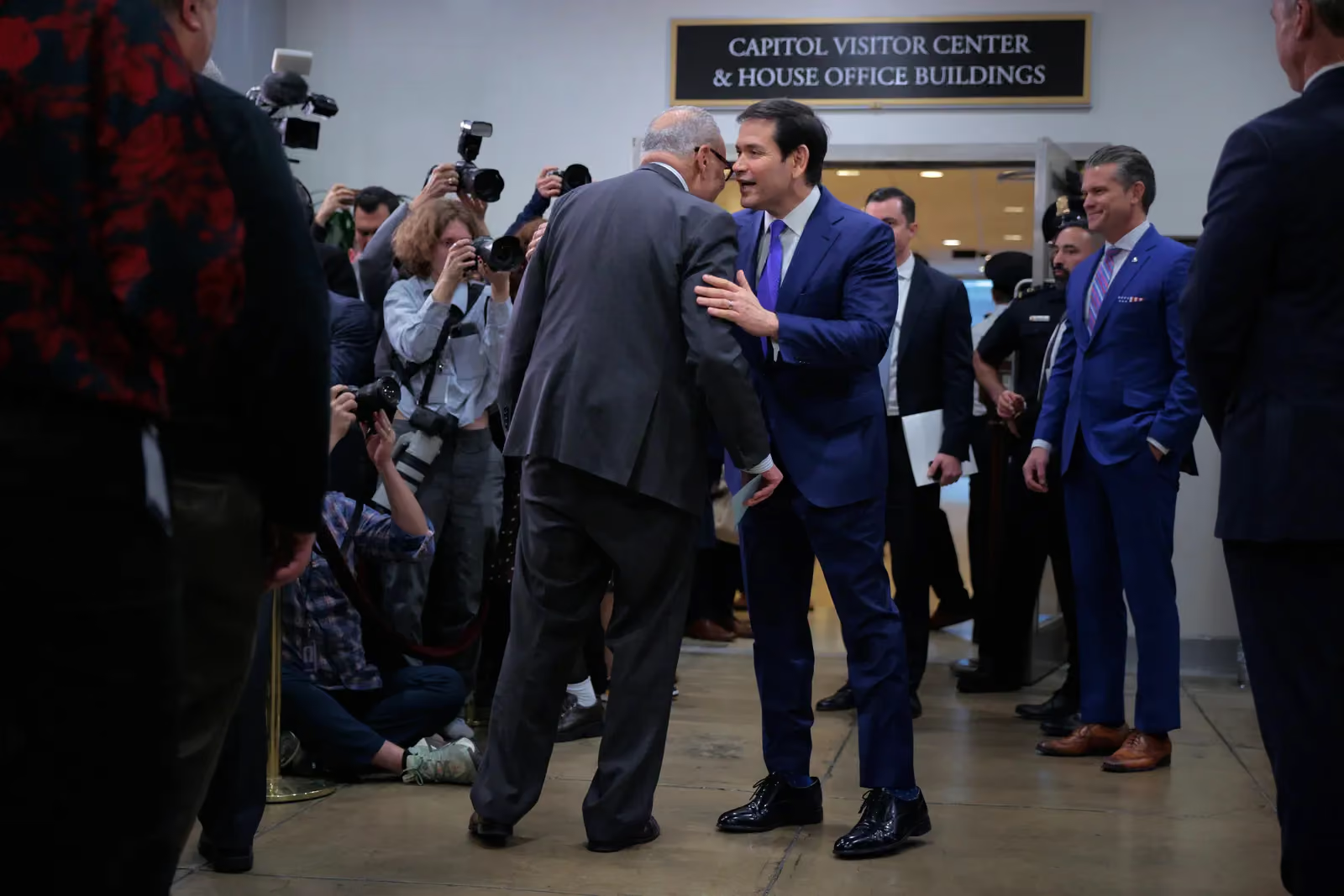
The story begins with a pair of shoes and an alleged insult. According to reporting that has since circulated widely, the President told both JD Vance and Marco Rubio that they had “shitty shoes”. Then he asked them for their shoe sizes. Vance wears a size 13. Rubio wears an 11.5. Shortly thereafter, both men along with other cabinet members and close allies, including Fox News host Sean Hannity and Commerce Secretary Howard Lutnick received four pairs of $145 Florsheim Oxford shoes, gifted personally by the President.
Florsheim is an American shoe company. Founded in Chicago and now based in Wisconsin, the brand earned its most iconic cultural moment when Michael Jackson wore a pair in the Thriller music video. The President’s enthusiasm for distributing these shoes; a recognizably American product, gifted at his personal initiative fits neatly within a broader narrative of domestic pride. But as with much of the symbolism emanating from this administration, the details resist the clean reading.
What caught the internet’s attention was not the shoes themselves, but a photograph from Capitol Hill in January 2026 showing Marco Rubio wearing a pair that were visibly too large for him. The excess space at the heel made clear he was wearing at least two sizes bigger than his own. A White House official, speaking anonymously, reportedly summed up the dynamic with a single damning line: “It’s hysterical because everybody’s afraid not to wear them.”
Whether Rubio miscalculated his shoe size out of insecurity — invoking the urban mythology that equates shoe size with masculine endowment, or simply wore the wrong size out of deference to the man who gave them, the image crystallizes something essential about the power dynamics at play.
As the President himself allegedly quipped: “You can tell a lot about a man by his shoe size.” The statement was meant as flattery. It landed as diagnosis.
The Florsheim episode is a small story, but it is a telling one. In administrations defined by loyalty above almost everything else, the act of wearing shoes that do not fit, that are uncomfortable, and are visibly wrong. It makes people wonder if cabinet members obey unconditionally on something as painfully personal as a wrong size of shoe, what other unconditional orders are they following? A shoe too big to walk comfortable becomes unexpectedly a precise metaphor for the broader culture of compliance. As Bette Midler once observed “I firmly believe that with the right footwear, one can rule the world”. The corollary, apparently, is that with the wrong footwear and enough fear, one will simply say nothing and keep walking.
The Performative Patriotism
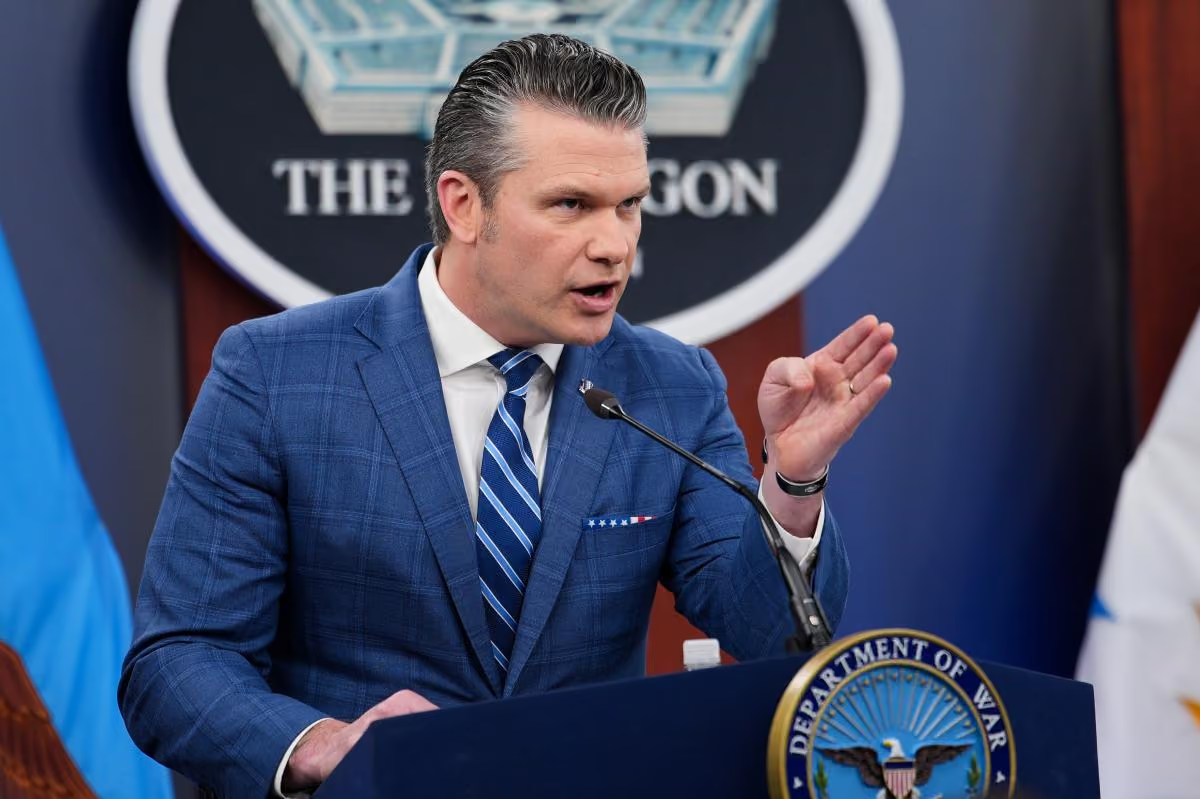
Pete Hegseth serves as Secretary of Defense, recently renamed as the Department of War, a rebranding that is itself a form of fashion, signaling a preference for aggression over diplomacy through nothing more than a word choice. Hegseth is no stranger to the mechanisms of public image: before his current role, he was a fixture on Fox News, where the performance of patriotism is both a professional requirement and an aesthetic.
His signature accessory has been seen by international press and even made it to a Saturday Night Live sketch. It’s been the fashion accessory that has drawn the most sustained commentary. It is a pocket square printed with the American flag. The choice has attracted sharp criticism from journalists and media commentators, most pointedly from MSNBC’ss Rachel Maddow, who noted the specific problem with precision:There’s a reason why you’re not supposed to use the actual American flag as clothing. But specifically, you’re not supposed to use it with something you blow your nose into.
This is not a minor etiquette complaint. The U.S. Flag Code, though rarely enforced, explicitly discourages using the flag as a garment or accessory. The spirit of that guidance is rooted in the idea that the flag is a shared national symbol, not a personal prop. When it appears on a handkerchief —an object associated with wiping, blowing, and discarding, the symbolism curdles.
Hegseth’s accessory choice is a case study in what might be called aesthetic nationalism: the deployment of patriotic imagery as personal branding rather than genuine conviction. It prioritizes the visual signal over the underlying meaning. This is not an accident of ignorance; it is the natural endpoint of a political culture in which optics have become entirely detached from substance.
The Inconsistent Message Through Fashion and Press Briefings
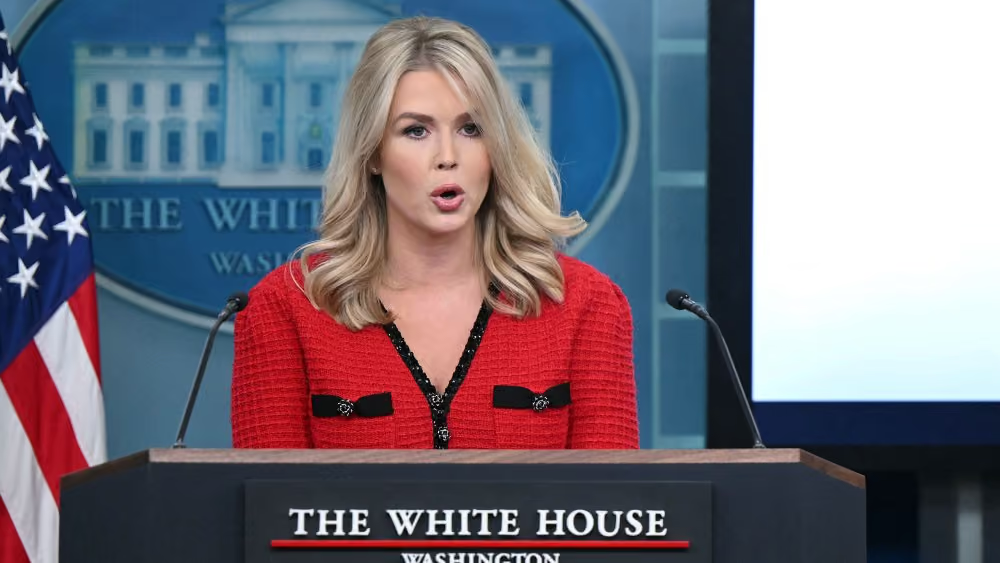
White House Press Secretary Karoline Leavitt occupies one of the most visible and symbolically loaded roles in American politics. As the daily public face of the executive branch, she is, by definition, a communications instrument. Every word calibrated, every appearance deliberate. Or so the role demands.
Setting aside the substance of her briefings, Leavitt’s sartorial choices reveal a recurring and curious inconsistency. This is not a matter of varying silhouettes or rotating color palettes. Variation is not inherently problematic. The issue is that her styling suggests different personas on different days, as though the visual identity of the administration’s spokesperson has not been anchored to any coherent communicative strategy. In a role where consistency and credibility are professionally inseparable, this visual instability registers.
But the most pointed moment came during the rollout of the administration’s tariff policy and the so-called “Liberation Day” announcement that imposed sweeping tariffs on imported goods, framed as a bold reclamation of American manufacturing. Leavitt stood at the podium in a red dress, a color chosen almost universally in politics to project authority and conviction. The optics were intentional but the irony was not.
Online observers quickly identified that the dress was made in China but this was not an isolated incident. Leavitt was spotted wearing China-manufactured clothing on multiple occasions while publicly championing a policy predicated on punishing Chinese imports and reviving domestic production. The tariffs themselves imposed duties of up to 145% on goods manufactured in China, devastating small and medium-sized American business owners who lacked the capital or infrastructure to rapidly relocate their supply chains. Many of the machines required for certain textile finishes and production standards simply do not exist in the United States at this time; a reality the policy appeared not to have accounted for.
The intent behind the tariffs and to reinvest in American labor and production was a coherent and legitimate policy goal. The execution was another matter entirely. And the image of the press secretary wearing Chinese-made clothing while defending the policy was not merely ironic but it was emblematic. It revealed, with unusual clarity, the distance between the rhetoric of economic nationalism and the lived reality of a supply chain that decades of globalization have made nearly impossible to disentangle overnight.
What the Mirror Shows
Fashion has always told the truth even when its wearers would prefer otherwise. This is what makes it such a reliable diagnostic tool for political communication. It operates just below the threshold of official messaging, revealing choices made in haste, without full consideration, or without the self-awareness that the moment demands.
What the current administration’s fashion choices collectively reveal is a profound disconnect between symbol and substance. A Secretary of Defense who wraps the flag around a handkerchief and calls it patriotism. A press secretary who advocates for American manufacturing in clothes made in China. Cabinet officials who wear ill-fitting shoes gifted by their boss not because the shoes suit them, but because declining would be politically dangerous. These are not minor aesthetic failures. They are symptoms of a culture in which performance has replaced principle, where the gesture toward an idea has become a substitute for the idea itself in order to follow a culture of spectacle and an attention economy.
Today’s administration offers something different: fashion as accident, as oversight, as unconsidered habit. And in a political environment where every image is documented, shared, and scrutinized within seconds of its creation, that carelessness carries a cost. The shoes that don’t fit, the flag that doesn’t belong on a pocket square, the dress that contradicts the speech. These are the details that cut through the noise of the news cycle precisely because they require no interpretation. They simply are what they are.
In a moment defined by contested narratives and information overload, fashion remains one of the few forms of political communication that cannot be walked back with a statement. You either wore it or you didn’t. The camera either caught it or it didn’t. And once it’s out there, the image speaks for itself. It is louder, often, than anything said at the podium.
.avif)